
No building in California is exempt from accessibility law because of its age. Federal dates from 1992 and 1993 decide which standard applies to a building and to its later alterations, not whether one applies. Existing facilities still owe ongoing barrier removal under the ADA, and California attaches its own obligations to anything built or altered since 1970.
For the owner of a building built before 1993, then, the real work is matching each part of the property to the rule that reaches it, and knowing which event switches each rule on. Usually that event is an alteration.
Is a Pre-1993 California Building Exempt From the ADA or State Law?
Neither law exempts it. The federal regulation for private businesses, 28 CFR Part 36, uses the January 26, 1993 occupancy date to sort buildings into new construction, held to full design standards, and existing facilities, held to barrier removal. California law does not grandfather old buildings either. Its Health and Safety Code Section 19955 and the sections that follow require privately funded public accommodations to meet the state’s access provisions, and the California Commission on Disability Access says plainly that no grandfathering provisions exist.
That 1993 date hides a second one. Under Section 36.401(a)(2), a facility counts as designed and constructed for first occupancy after January 26, 1993 only if both conditions hold: the last application for a building permit or permit extension was certified complete after January 26, 1992, and the first certificate of occupancy was issued after January 26, 1993. A building that opened in 1994, with its last permit application completed in 1991, fails the first condition. Federally, it is an existing facility. The state approach is simpler, since the CCDA ties California’s obligations to the act of building or altering, whatever the occupancy date.
Public entities answer to a different rule. Title II entities such as cities and counties follow 28 CFR Part 35, whose Section 35.151 draws the line at construction commenced after January 26, 1992; for older buildings the federal duty is program access, judged by each service or program in its entirety rather than building by building. California layers its own statute on top. Government Code Section 4450(a) requires buildings constructed with state or local public funds to conform to the state’s access standards, and the Division of the State Architect enforces them on public school and community college projects.
| Rule | Date that matters | What the date decides |
|---|---|---|
| ADA Title III, new construction | First certificate of occupancy after January 26, 1993 AND last permit application certified complete after January 26, 1992 | Whether the building is held to full new construction standards or treated as an existing facility |
| ADA Title III, alterations | Physical alteration begun after January 26, 1992 | The altered portions must be accessible to the maximum extent feasible |
| ADA Title II, public entities | Construction commenced after January 26, 1992 | Whether a government facility is held to new construction standards |
| ADA Title III, existing facilities | No cutoff date: the duty is ongoing | Barrier removal wherever it is readily achievable |
| California state law | Built or altered since 1970 | State obligations attach at the time of construction or alteration; code changes generally reach an existing building only when it is altered |
Barrier Removal in California: Parking and Curb Cuts First
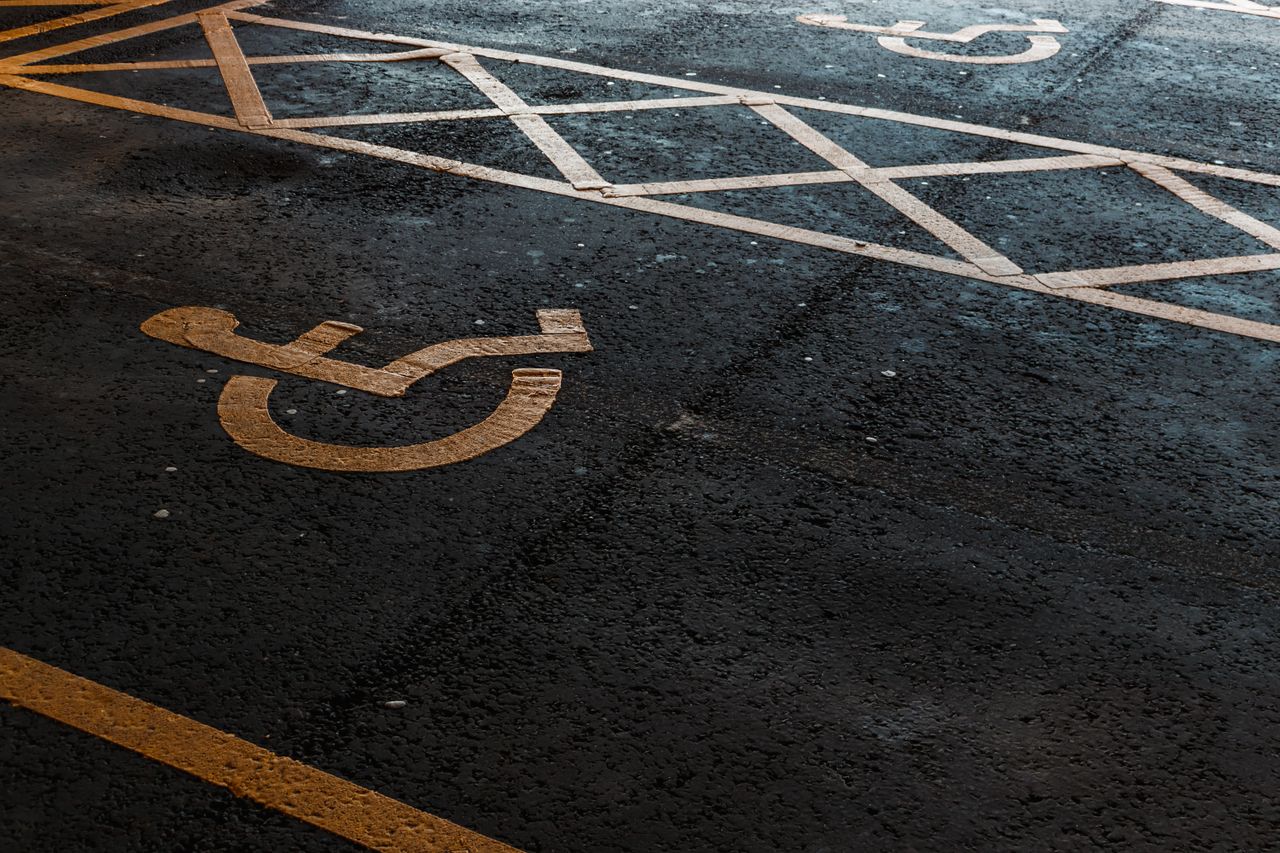
Start with the parking lot and the route from it to the door. Section 36.304(c) of the federal rule urges an order of priorities for barrier removal, and the first is access from public sidewalks, parking or public transportation, with accessible parking spaces among its examples. California’s code points the same way: under Exception 4 to Section 11B-202.4, barrier removal done under the ADA or under the state code’s own access requirements stays within its scope, so a parking project does not trigger the path of travel requirements.
The obligation behind that list never expires. The federal rule requires barrier removal in existing facilities wherever it is readily achievable, meaning easily accomplishable and able to be carried out without much difficulty or expense, and the CCDA describes it as an ongoing duty even in a building that has never been altered. Federally, barrier removal already stays out of path of travel (Section 36.304(d)(1)). Exception 4 is the state’s mirror of that rule, extended to barrier removal under the California Building Code itself. Both lists name the same two pavement jobs: creating designated accessible parking spaces, and making curb cuts in sidewalks and entrances.
Each barrier removal measure has to meet the alteration standard for the element it changes, so a new accessible stall is laid out to that standard rather than to whatever fits between the old lines. In California the stall also answers to Chapter 11B, because Section 11B-202.3 requires every altered element to comply with the code. Where full compliance is not readily achievable, the federal rule permits a partial measure, such as a ramp with a steeper slope, provided it poses no significant risk to health or safety. Portable ramps should be used only when a permanent one is not readily achievable.
Where a business can show that barrier removal is not readily achievable, Section 36.305 still requires it to offer its goods and services through alternative methods that are, such as curb service or home delivery. If the budget covers only one improvement this year, make it the parking and the route to the entrance: the federal list ranks that work first, and California’s Exception 4 keeps the project inside its own scope.
An access barrier in California can also bring claims for statutory damages under state civil rights law. When an owner cannot tell what is readily achievable at a given property, the CCDA’s advice is to hire a Certified Access Specialist (CASp).
The 1991 Safe Harbor and Why California’s Is Shorter
California’s version is shorter because it only works inside an alteration and only reaches back one edition of the code. The federal safe harbor, in Section 36.304(d)(2)(i), shelters any element not altered on or after March 15, 2012 that complies with the 1991 Standards, with no upgrade to the 2010 Standards required. Exception 2 to Section 11B-202.4 covers path of travel elements when an alteration triggers them, and then only if they meet the immediately preceding edition of the California Building Code.
The federal word that matters is complies. An original element of a building designed before the 1991 Standards existed has no built-in reason to meet them, so an owner cannot assume the harbor applies; the element has to be measured against the 1991 text. Supplemental requirements get no harbor at all. The federal rule lists elements the 1991 Standards never addressed, among them swimming pools, play areas, exercise equipment and golf facilities, and those must meet the 2010 Standards to the extent readily achievable. Public entities get a slightly wider federal harbor, since the Title II version also accepts the Uniform Federal Accessibility Standards (28 CFR 35.150(b)(2)). None of these federal shelters excuses an element from the California Building Code once it is altered.
On the California side, Exception 2 names the elements it protects, among them the primary entrance and the restrooms serving the altered area. They do not have to have been built under a permit issued under the preceding edition; they only have to comply with it. The note to the exception says it permits a reference back to one CBC edition only and is not accumulative, and the Division of the State Architect warns against stretching it to earlier editions. An element that met an older edition, and nothing since, gets no relief. Nothing here applies until someone alters the building.
California’s Own Clock: State Law, the CBC and Multistory Buildings
California’s access obligations started earlier than the federal ones, but they attach to construction and alteration, not to the calendar. The California Commission on Disability Access ties them to anything built or altered since 1970 under state law. The Division of the State Architect supplies the other half in its advisory to Section 11B-202.3: code changes do not generally trigger compliance with the current code in an existing building unless that building is undergoing alteration. Federal barrier removal, by contrast, applies whether or not anyone pulls a permit.
A building permit does not settle the question. The CCDA lists “built with a permit” among the common misconceptions, because construction shortcomings and plain wear routinely leave permitted buildings out of compliance, and because the ADA is a civil rights law that local building departments do not enforce.
One state provision targets older multistory buildings directly. Exception 9 to Section 11B-202.4 says certain privately funded multistory buildings were once exempt from access requirements above and below the first floor and, as of April 1, 1994, are no longer exempt, because of more restrictive provisions in the federal ADA. The list covers office buildings and passenger vehicle service stations of three or more stories with 3,000 or more square feet per floor, offices of physicians and surgeons, shopping centers, and other buildings of that size that offer a reasonable portion of their public services on the accessible level. When one of those buildings, approved and built without an elevator, is altered, the code’s cost limit for path of travel work applies to the floors above and below the ground floor, even on a large project.
When Work on an Old Building Opens the Path of Travel
As the CCDA defines it, an alteration is almost any construction or renovation that affects or could affect the usability of the building, tenant remodels included and purely cosmetic changes such as paint and carpet excluded. Once that happens, Section 11B-202.4 requires an accessible path of travel to the altered area, including a primary entrance and the restrooms, drinking fountains, public telephones and signs serving it. Parking lots get a narrow pass. Under Exception 5, resurfacing or restriping an existing lot stays limited to that work and does not trigger the path of travel by itself.
Each new edition of the California Building Code moves the “immediately preceding” line forward one step. Subscribe to the blog to get a note when California updates the rules that govern older buildings.
References
-
U.S. Department of Justice. (2024). 28 CFR Part 36, Section 36.304 Removal of barriers and Section 36.305 Alternatives to barrier removal (7-1-24 edition) U.S. Government Publishing Office. https://www.govinfo.gov/content/pkg/CFR-2024-title28-vol1/pdf/CFR-2024-title28-vol1-sec36-304.pdf
-
U.S. Department of Justice. (2024). 28 CFR Part 36, Section 36.401 New construction and Section 36.402 Alterations (7-1-24 edition) U.S. Government Publishing Office. https://www.govinfo.gov/content/pkg/CFR-2024-title28-vol1/pdf/CFR-2024-title28-vol1-sec36-401.pdf
-
U.S. Department of Justice. (2024). 28 CFR Part 35, Section 35.150 Existing facilities (7-1-24 edition) U.S. Government Publishing Office. https://www.govinfo.gov/content/pkg/CFR-2024-title28-vol1/pdf/CFR-2024-title28-vol1-sec35-150.pdf
-
U.S. Department of Justice. (2024). 28 CFR Part 35, Section 35.151 New construction and alterations (7-1-24 edition) U.S. Government Publishing Office. https://www.govinfo.gov/content/pkg/CFR-2024-title28-vol1/pdf/CFR-2024-title28-vol1-sec35-151.pdf
-
Division of the State Architect. (2026). 2025 California Access Compliance Advisory Reference Manual, Advisory 1.1.2, Section 11B-202.3 and Advisory, Section 11B-202.4 Exceptions 2, 4, 5 and 9 California Department of General Services. https://www.dgs.ca.gov/-/media/Divisions/DSA/Publications/access/2025-CBC-Advisory-Manual-Triennial.pdf
-
California Commission on Disability Access. (2018). Accessibility Compliance for Businesses: Myths and Misconceptions, Myths 1 and 2 (updated June 2018) California Department of General Services. https://www.dgs.ca.gov/-/media/Divisions/CCDA/CCDA-Miscellaneous-Organized/_Myths-and-Misconceptions-2019.pdf
All references verified and publicly accessible
adapaving.org