California commercial property owners, facility managers, and paving contractors face some of the strictest physical accessibility regulations in the United States. While federal accessibility guidelines establish national baselines, the 2022 California Building Code Chapter 11B imposes specialized dimensional, geometric, and marking mandates for exterior parking facilities and path-of-travel routes. Failing to align asphalt resurfacing or re-striping projects with California Title 24 standards creates severe legal exposure under state civil rights statutes. Understanding the specific structural rules, pavement markings, and valuation thresholds defined in Chapter 11B is essential for maintaining compliant exterior grounds and avoiding costly statutory penalties.
What Is the 2022 California Building Code Chapter 11B?
California Building Code Chapter 11B sets state-level physical accessibility standards for public buildings, commercial facilities, and public accommodations across California. Published as Part 2 of Title 24 of the California Code of Regulations, Chapter 11B is regulated by the Division of the State Architect and enforced by local municipal building departments during permit review and site inspections. Under California Civil Code Section 52, non-compliant physical barriers expose business owners to statutory damages of $4,000 per each occasion a person was denied access plus attorney fees, making strict adherence to state construction codes a critical operational requirement.
The 2022 edition of the California Building Code took effect on January 1, 2023 and was superseded by the 2025 edition, effective January 1, 2026. Projects permitted today are reviewed against the current edition, so confirm the governing edition with the local building official before relying on any figure below. Unlike states that rely exclusively on federal standards, California enacts localized code modifications that exceed federal requirements. When state accessibility provisions establish tighter physical parameters than national mandates, California law strictly enforces the more stringent specification. Proactively scheduling a CASp inspection benefits property owners by establishing legal protection mechanisms under state law while identifying technical non-compliance items across exterior paving, walkways, and parking stalls.
CBC 2022 vs. Federal ADA Standards for Parking Lots
While federal 2010 ADA Standards serve as the baseline baseline across the United States, California Building Code Chapter 11B mandates larger stall dimensions, distinct blue border markings, and specific pavement lettering. Standard accessible parking stalls in California require a minimum width of 108 inches (9 feet), whereas federal guidelines allow standard stalls to measure 96 inches (8 feet). Additionally, California mandates that every access aisle be outlined with painted blue borders and feature diagonal hatching lines spaced no more than 36 inches on center, alongside mandatory painted pavement warnings that do not exist under federal rules.
Property owners who rely solely on federal design templates frequently incur construction violations in California. The state requires “NO PARKING” painted in 12-inch high white letters within every access aisle, as well as distinct perimeter line markings painted in blue. When executing accessible parking striping, contractors must apply California-specific color specifications, blue retroreflective borders, and specific stall width ratios. Adhering strictly to federal guidelines while ignoring Chapter 11B requirements results in non-compliant exterior spaces, failed municipal final inspections, and exposure to state accessibility lawsuits.
Key Parking Space & Access Aisle Dimensions (CBC Section 11B-502)
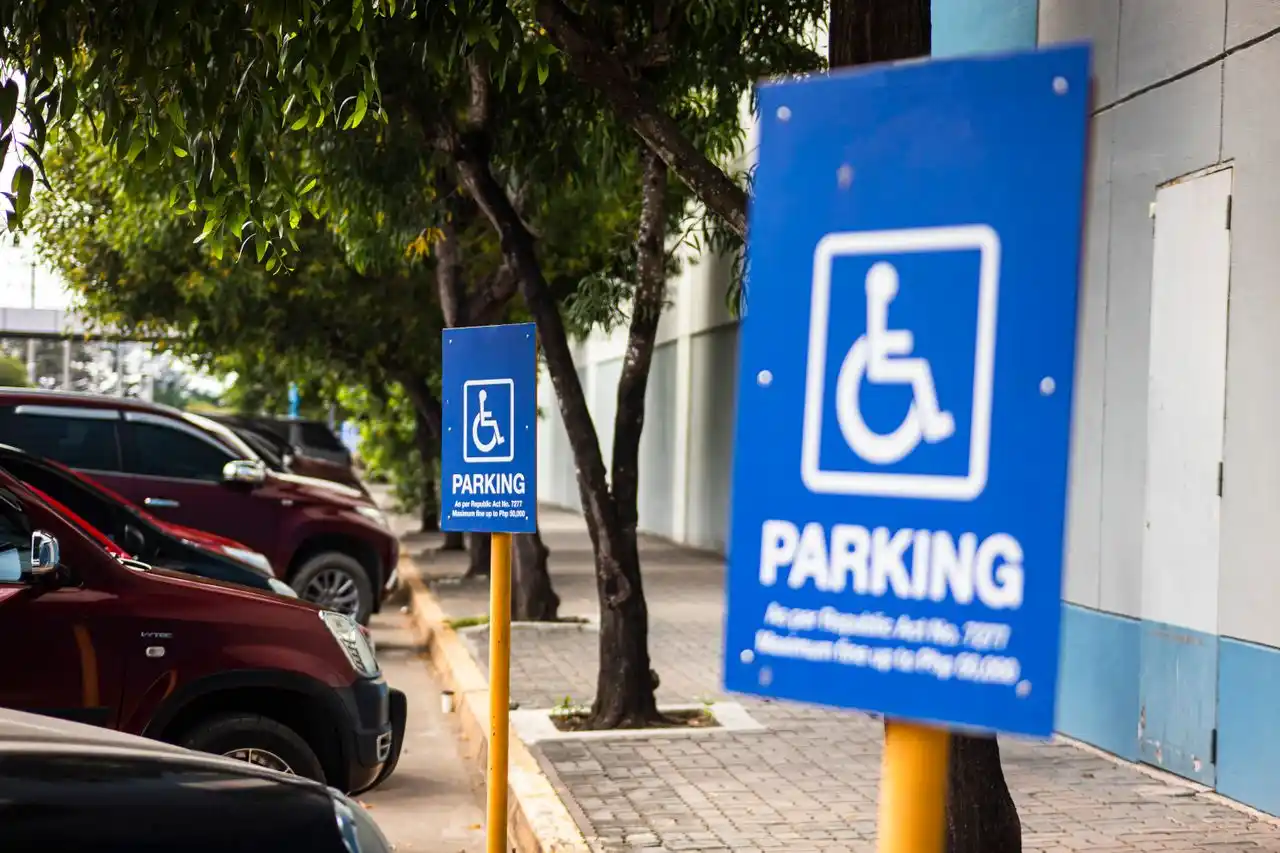
California Building Code Section 11B-502 defines exact physical geometry, slopes, and painted features for accessible parking stalls and access aisles. Standard vehicle stalls require a minimum width of 108 inches (9 feet), van stalls require 144 inches (12 feet) of width (or 108 inches if paired with a 96-inch access aisle), and all accessible stalls must measure at least 216 inches (18 feet) in length. Access aisles adjacent to standard and van stalls must measure at least 60 inches (5 feet) in width, extend the full length of the parking space, and connect directly to an accessible route to the building entrance.
- Standard accessible vehicle stall width: 108 inches minimum (CBC Section 11B-502.2)
- Van accessible stall width: 144 inches minimum (or 108 inches with a 96-inch access aisle)
- Stall length: 216 inches minimum across all accessible space types
- Access aisle width: 60 inches minimum (80 inches for designated van aisles paired with 108-inch stalls)
- Maximum slope limit: 1:48 (2.08%) maximum slope in all directions for stalls and access aisles (CBC Section 11B-502.4)
- Access aisle legend: “NO PARKING” painted in 12-inch high white letters (CBC Section 11B-502.3.3)
- Pavement symbol: International Symbol of Accessibility (ISA) measuring 36 inches by 36 inches painted in white on a blue background (CBC Section 11B-502.6.4)
Pavement slope control is one of the most strictly audited aspects of exterior paving compliance. Slopes inside accessible stalls or access aisles exceeding 2.08% in any direction violate Section 11B-502.4. When asphalt surfaces settling creates localized depressions, property owners must reconstruct the subgrade or perform surface grinding to restore compliance. Furthermore, adjacent connecting walkway ramps must not exceed an 8.33% (1:12) longitudinal slope, while maintaining cross slopes within 2.08% to ensure seamless transitions along ADA ramp slopes.
Total Required Accessible Spaces (Table 11B-208.2)
California Building Code Table 11B-208.2 establishes the mandatory minimum number of accessible parking stalls based on total parking lot capacity. Facilities offering public parking must calculate compliance per individual parking facility rather than aggregating spaces across separate lots. Under California Building Code Section 11B-208.2.4, at least one out of every six accessible spaces (or fraction thereof) must be constructed as a van-accessible space, featuring extra width, expanded vertical clearance of 98 inches along the vehicle route, and dedicated van accessibility signage.
Certain occupancy types in California trigger higher accessibility ratios than standard commercial properties. Outpatient physical therapy facilities and rehabilitation centers require 20% of total parking spaces to be accessible under California Building Code Section 11B-208.2.1. Medical facilities specializing in mobility treatment must provide accessible parking for 10% of total patient and visitor capacity. When repaving or modifying existing parking facilities, property owners must recalculate total stall counts to ensure compliance with Table 11B-208.2 ratios.
Path of Travel & The 2026 Valuation Threshold (Section 11B-202.4)
When an alteration is performed on an existing commercial facility, California Building Code Section 11B-202.4 mandates upgrades to the accessible path of travel. Resurfacing and restriping sit outside that duty: Exception 5 to the same section limits them to the actual scope of the work and states they are not required to comply with the path of travel section. For projects with an adjusted construction cost under the Division of the State Architect 2026 valuation threshold of $209,208.00, required path of travel improvements are capped at 20% of the total project budget. If the adjusted construction cost exceeds $209,208.00, the 20% cap no longer applies and full compliance is expected for the entire path of travel connecting the altered area to the public right-of-way. The same 20% then works in the opposite direction: only with a finding of unreasonable hardship does the code state that in no case shall the cost of compliance be less than 20% of the adjusted construction cost. The full breakdown of what counts toward that adjusted cost, and which direction the 20% runs, sits in a separate guide.
- Primary entrance serving the altered area
- Exterior pedestrian route connecting public sidewalk or transit stops to entrance
- Accessible parking stalls and access aisles serving the facility
- Restroom facilities designated for public or employee use in altered area
- Public pay telephones and drinking fountains along the path of travel
Section 11B-202.4 Exception 8 sets the order of priority in which accessibility funds are allocated when the path of travel obligation applies. Upgrading accessible parking stalls and exterior walkways ranks highest among exterior paving requirements. Routine maintenance work such as minor crack filling, localized patch repair, or surface sealing that does not alter structural pavement depth does not trigger path-of-travel obligations. Resurfacing and restriping do not trigger them either, which is the point of Exception 5. Work that goes beyond resurfacing into reconstruction of the facility is evaluated as an alteration on its own terms.
Staying fully aligned with evolving California accessibility laws requires continuous monitoring of Division of the State Architect updates and Title 24 code revisions. Subscribe to the ADA Paving California educational newsletter to receive technical compliance guides, regulatory threshold updates, and practical pavement engineering insights directly in your inbox.