
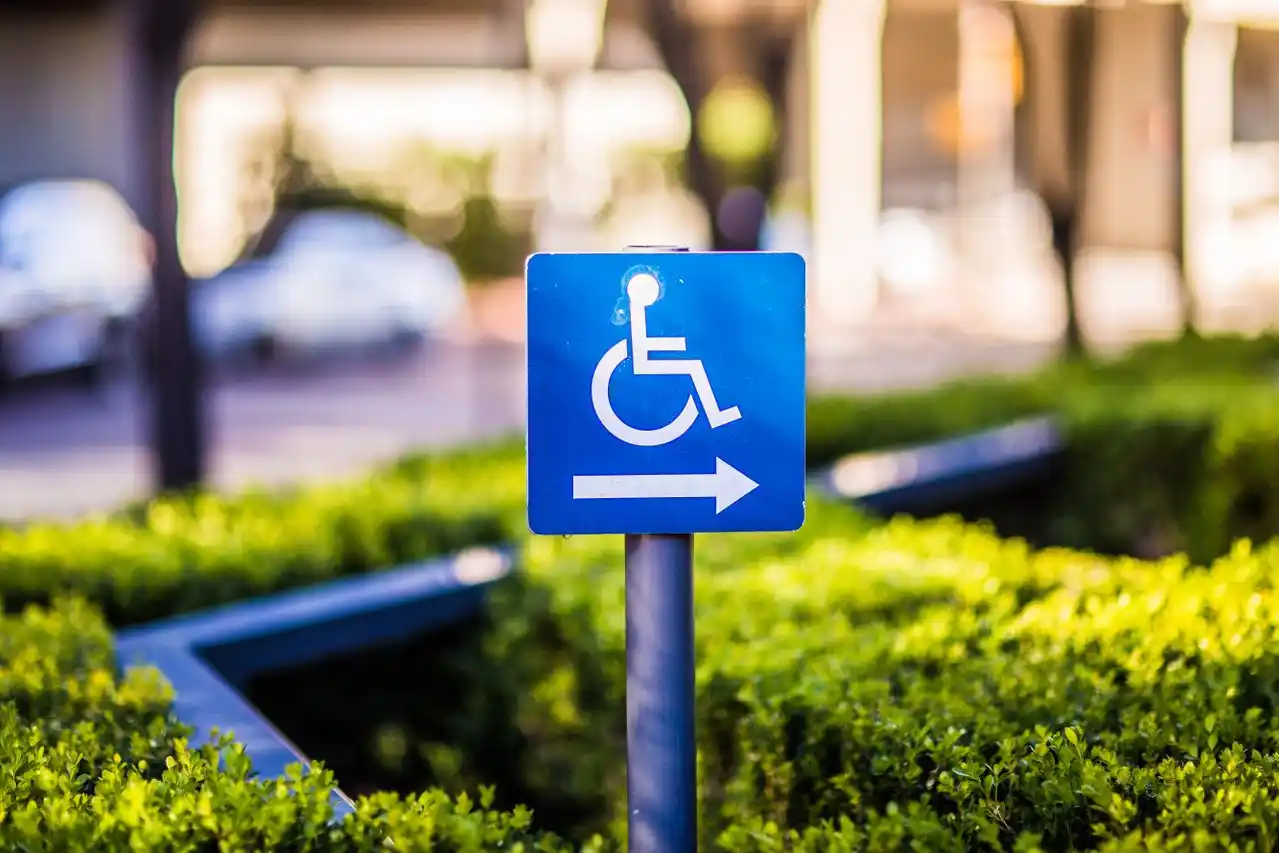
Property managers and commercial building owners operating in California face some of the strictest physical accessibility regulations in the United States. While federal standards establish baseline rules nationwide, California enforces additional layers through Title 24 of the California Code of Regulations and the California Building Code Chapter 11B.
Navigating these overlapping mandates requires precision. Failing to install proper tactile wall signs, geometric door markers, or accessible parking signs exposes property owners to statutory damages under California Civil Code Section 55.56, where non-compliant signage can trigger minimum statutory damages of $4,000 per violation. This guide breaks down the exact mounting locations, visual contrast rules, and geometric specifications required for full compliance with both state and federal law.
Federal ADA vs. California Building Code (CBC 11B) Signage Rules
Federal accessibility guidelines and California building standards share common goals, but California law regularly establishes stricter design and installation specifications that supersede baseline federal rules. Under the United States Department of Justice 2010 ADA Standards for Accessible Design, commercial facilities must provide accessible signage across permanent rooms, exit paths, and designated parking areas. However, property owners in California must primarily satisfy the California Building Code Chapter 11B, administered by the Division of the State Architect.
When state and federal regulations address the same structural element, the rule providing the greater degree of accessibility applies. For instance, while federal rules permit a single tactile sign on wall surfaces adjacent to single-user restrooms under Section 703, California Title 24 mandates a dual-sign system that adds a high-contrast geometric shape directly to the door exterior.
Furthermore, California enforcement differs significantly regarding monetary penalties. Federal ADA enforcement typically focuses on injunctive relief and forced structural corrections, whereas California Civil Code Section 55.56 allows private plaintiffs to claim $4,000 in statutory damages for accessibility barriers that cause difficulty, discomfort, or embarrassment. Aligning physical signage with California Building Code standards is essential for passing Certified Access Specialist inspections and maintaining legal compliance.
Wall Mounting Height and Placement Rules for Tactile Signs
Tactile signs identifying permanent rooms or doors must follow precise vertical and horizontal placement tolerances to allow individuals who are blind or visually impaired to locate and read them safely. California Building Code Section 11B-703.4.1 mandates that signs with raised characters and Braille must be installed on the wall adjacent to the latch side of the door. If a door lacks a clear latch side, such as double doors with one active leaf, the sign must mount on the nearest adjacent wall surface.
The vertical mounting height is measured directly from the finish floor surface to the baseline of the raised tactile characters. According to California Building Code Section 11B-703.4.1 and Section 703.4 of the federal standard, the lowest line of tactile characters must sit at a minimum of 48 inches above the finish floor, while the baseline of the highest line of tactile characters cannot exceed 60 inches. Additionally, installers must maintain an 18-inch by 18-inch clear floor space centered directly in front of the tactile sign, positioned beyond the arc of any door swing to protect pedestrians from accidental door contact while reading.
Interactive mounting height calculator and latch clearance preview
Clear Floor
Restroom Signage Requirements in California (The Two-Sign System)
Sanitary facilities in California are subject to a distinctive dual-sign mandate that combines traditional ADA tactile indicators with California’s historic Title 24 geometric visual symbols. While property managers unfamiliar with California regulations often install a single wall sign, compliance inspectors enforce both elements simultaneously. Failing to provide either sign on a public or employee restroom results in a building code violation.
The primary door-mounted visual sign utilizes geometric shapes specified in California Building Code Section 11B-703.7.2.1. This visual indicator must mount directly onto the face of the restroom door, centered horizontally between 58 inches and 60 inches above the floor, measured to the center of the shape:
- Men’s Restroom: An equilateral triangle with edges measuring 12 inches, apex pointing upward, featuring a blue symbol on a light background or contrasting dark shade.
- Women’s Restroom: A circle measuring 12 inches in diameter with a color contrasting directly against the surface of the door.
- Unisex or All-Gender Restroom: A circle measuring 12 inches in diameter with a 12-inch equilateral triangle superimposed inside the circle.
The secondary sign is the standard wall-mounted tactile identifier required by California Building Code Section 11B-703.2. Installed on the wall adjacent to the door latch, this wall sign must display raised tactile sans-serif text, California Grade 2 Braille, and the International Symbol of Accessibility if the facility offers an accessible parking striping connection to an accessible entrance.
Accessible Parking Signage Standards in California
Designating accessible vehicle stalls requires specialized overhead signage that remains clearly visible over parked vehicles. Under California Building Code Section 11B-502.6, every designated accessible parking space must display a sign displaying the International Symbol of Accessibility. These signs must be reflective and mounted at a height that prevents obstruction by parked passenger cars or vans.
Vertical mounting heights for parking signs depend heavily on pedestrian circulation paths. The federal baseline mandates a minimum mounting height of 60 inches from the ground to the bottom edge of the lowest sign panel. However, California Building Code Section 11B-502.6 overrides this standard when a sign is located within or along a pedestrian circulation path, raising the mandatory clearance height to 80 inches minimum above the finished pavement surface to eliminate head injury hazards for visually impaired pedestrians entering from covered disabilities under ADA access routes.
California parking facilities must also incorporate specific auxiliary text plates below or within the primary sign structure:
- Van Accessible Identification: Spaces designated for wheelchair accessible vans must include an additional plate stating “Van Accessible” mounted directly below the International Symbol of Accessibility.
- Towing Warning Requirement: According to California Vehicle Code Section 22511.8, every public parking facility entrance must display a prominent notification sign stating that unauthorized vehicles parked in spaces designated for persons with disabilities will be towed away at the vehicle owner’s expense.
- Minimum Fine Designation: California accessible parking signs must clearly display the mandatory minimum fine text plate stating “$250 Minimum Fine” to comply with state law.
Visual and Tactile Design Specifications (Fonts, Contrast, and Braille)
The physical construction of ADA-compliant signs requires strict compliance with manufacturing standards covering surface reflectivity, stroke thickness, letter proportions, and tactile character elevation. California Building Code Section 11B-703.5 mandates that characters and background surfaces maintain a non-glare finish (matte or eggshell) to accommodate individuals with low vision who are sensitive to light reflection.
Text visual contrast must meet high percentage differentials. Signs must feature either dark characters on a light background or light characters on a dark background, maintaining a minimum 70 percent contrast ratio between elements. When selecting typography, tactile characters must feature uppercase sans-serif fonts (such as Helvetica, Arial, or Futura) free from decorative flourishes, serifs, or italics. Under California Building Code Section 11B-703.2.2, character height must range between 5/8 inch minimum and 2 inches maximum, raised exactly 1/32 inch minimum from the sign surface.
Braille placement in California involves specifications that exceed federal standards. California Building Code Section 11B-703.3 mandates the use of California Grade 2 Braille, which features specific contracted spacing and domed or rounded dots rather than flat or pointed projections. The Braille text must sit positioned directly below the corresponding tactile character line, maintaining a minimum vertical clearance of 3/8 inch to 1/2 inch to prevent finger interference when reading tactile text. Additionally, property managers maintaining outdoor path routes must regularly inspect adjacent pathways to ensure continuous smooth access, taking care to repair vertical displacements that exceed federal trip hazard height limits before final sign installation.
Staying compliant with evolving California accessibility laws requires continuous monitoring of local building codes and state updates. Subscribe to the ADA Paving California educational newsletter to receive statutory compliance checklists, state regulation updates, and technical guides designed for commercial property management.
References
-
U.S. Department of Justice. (2010). 2010 ADA Standards for Accessible Design, Section 703 Signs. Civil Rights Division. https://www.ada.gov/regs2010/2010ADAStandards/2010ADAstandards.htm#pgfId-1006622
-
California Building Standards Commission. (2022). California Building Code Title 24 Part 2, Chapter 11B Accessibility to Public Buildings, Section 11B-703. Division of the State Architect. https://www.dgs.ca.gov/DSA/Publications
-
California State Legislature. (2023). California Vehicle Code Section 22511.8 Off-Street Parking: Disabled Person Spaces. California Legislative Information. https://leginfo.legislature.ca.gov/faces/codes_displaySection.xhtml?lawCode=VEH§ionNum=22511.8
-
California State Legislature. (2022). California Civil Code Section 55.56 Compliance Fine and Damage Standards. California Legislative Information. https://leginfo.legislature.ca.gov/faces/codes_displaySection.xhtml?sectionNum=55.56.&lawCode=CIV
All references verified and publicly accessible
adapaving.org