State and local government agencies in California must ensure that all public services, activities, and physical facilities remain fully accessible to individuals with disabilities. Governed by federal regulations alongside state building standards, compliance requires careful coordination across physical paved routes, parking areas, and administrative policies. Understanding what is the ADA Title II framework helps public administrators maintain compliant facilities while reducing legal exposure under California law.
Title II applies exclusively to public entities, establishing strict rules for both existing facilities and new construction. While federal regulations set baseline requirements, public agencies operating in California must navigate the interplay between federal guidelines and the California Building Code, which often mandates higher accessibility standards for physical infrastructure.
What Is ADA Title II and Who Does It Apply To?
Under 28 C.F.R. Section 35.104, Title II of the Americans with Disabilities Act applies to all public entities at the state and local government levels. A public entity encompasses any department, agency, special district, or other instrumentality of state or local government, regardless of whether the entity receives federal financial assistance.
In California, Title II governs a broad spectrum of public operations, including city halls, county courthouses, public school districts, municipal transit hubs, public parks, and police departments. Unlike Title III, which applies to private businesses operating public accommodations, Title II imposes affirmative duties on government bodies to ensure that qualified individuals with disabilities are not excluded from participating in or benefiting from public services, programs, or activities.
When public entities contract out services or lease facilities to third-party operators, Title II obligations remain with the government body. Facilities managed on behalf of a public agency including leased parking lots or public-private recreational sites must comply with Title II standards, ensuring that physical access from public rights-of-way directly aligns with regulatory provisions.
The Program Accessibility Standard vs. Physical Structural Compliance
For facilities constructed prior to January 26, 1992, 28 C.F.R. Section 35.150 sets forth the program accessibility standard. Under this standard, a public entity is not necessarily required to make every existing facility physically accessible, provided that the overall service, program, or activity is readily accessible to and usable by individuals with disabilities. However, public entities cannot rely on “grandfather clauses,” as no such protection exists under federal or California accessibility law.
When program relocation or administrative adjustments are insufficient to provide equal access, physical alterations become mandatory. Under 28 C.F.R. Section 35.151, any new construction or physical alteration initiated after January 26, 1992, must strictly adhere to physical accessibility design standards. Facilities altered by or on behalf of a public entity must ensure that the path of travel to the altered area remains accessible to the maximum extent feasible.
If a public entity attempts to claim that a structural modification causes an undue financial or administrative burden, 28 C.F.R. Section 35.150 requires a formal written decision by the head of the agency detailing the specific reasons for that determination. Even if an undue burden is established, the entity remains legally obligated to take any other action that would ensure program accessibility to the maximum extent possible.
Title II Physical Infrastructure Standards in California: ADA vs. CBC Chapter 11B
Physical compliance for public facilities in California requires navigating both federal ADA standards and the California Building Code (CBC) Chapter 11B. Under California Civil Code Section 55.56, public entities face statutory damages if a physical barrier denies full and equal access or deters an individual from accessing a public facility. Where federal and state standards differ, California public entities must apply whichever provision affords greater physical accessibility.
Public parking areas, curb ramps, and pedestrian pathways serving government buildings must comply with specific structural dimensions. For example, while federal standards establish basic accessible parking counts, California requires specific vanity width allocations and continuous visual boundaries. Additionally, public pedestrian crossings and curb ramps leading into civic buildings must incorporate approved truncated domes to serve as tactile ground surface indicators for visually impaired pedestrians.
Maintaining accurate accessible parking requirements across civic properties ensures that van-accessible stalls, loading aisles, and path-of-travel routes seamlessly connect public parking structures to primary building entrances without steep slopes or sudden vertical level changes.
Van Accessible Parking Stall: Minimum 132 inches wide with a 60-inch adjacent access aisle, or 96 inches wide with a 96-inch access aisle.
Detectable Warnings: Required primarily at transit platform edges; optional at standard curb ramps unless specified by local guidelines.
Signage Height: Signs must be mounted at a minimum of 60 inches above the finish floor or ground surface to the bottom of the sign.
Van Accessible Parking Stall: Minimum 168 inches wide (14 feet) total, configured as a 108-inch stall with a 60-inch aisle, or a 108-inch stall with a 108-inch aisle under CBC Section 11B-502.2.
Detectable Warnings: Mandatory truncated domes extending 36 inches deep at curb ramps, island crossings, and hazardous vehicular areas under CBC Section 11B-705.1.
Signage & Markings: Requires an additional “Minimum Fine $250” sign and white painted warnings (“NO PARKING”) inside access aisles under CBC Section 11B-502.3.3.
Administrative Obligations: ADA Coordinators, Transition Plans, and Complaints
Under 28 C.F.R. Section 35.107, public entities employing 50 or more persons must designate at least one employee to coordinate Title II compliance efforts. The public entity must publish the name, office address, and telephone number of the designated ADA Coordinator. Furthermore, qualifying public bodies must adopt and publish formal grievance procedures providing for prompt and equitable resolution of complaints alleging noncompliance with Title II.
Public entities with 50 or more employees that manage public rights-of-way, roads, or physical facilities are also required to maintain a detailed Transition Plan under 28 C.F.R. Section 35.150(d). This plan identifies physical obstacles in the entity’s facilities that limit accessibility, describes in detail the methods that will be used to make the facilities accessible, and specifies the schedule for taking the steps necessary to achieve full compliance.
Administrative oversights such as failing to maintain an updated Transition Plan or neglecting public barrier complaints frequently serve as primary evidence in state court proceedings. When an individual encounters a physical barrier in a government parking lot or sidewalk, administrative noncompliance can substantiate claims under California Civil Code Section 55.56, leading to statutory monetary penalties against the public entity.
Digital Accessibility Integration Under 28 C.F.R. Section 35.200
Title II obligations extend beyond traditional physical architecture to encompass digital infrastructure managed by state and local governments. Under 28 C.F.R. Section 35.200, public entities must ensure that their web content and mobile applications conform to Web Content Accessibility Guidelines (WCAG) 2.1 Level AA technical standards.
Digital accessibility overlaps directly with physical infrastructure when public entities deploy electronic kiosks, digital parking meters, or online reservation portals for public park facilities. If a municipal parking lot requires drivers to pay via a digital kiosk or mobile app, both the physical reach range of the kiosk and the digital user interface must remain fully accessible.
Ensuring that digital interfaces and physical infrastructure operate in tandem prevents gaps in program access. Municipalities must audit physical payment stations for ground space clearance while simultaneously verifying that mobile parking software supports screen readers and alternative input systems.
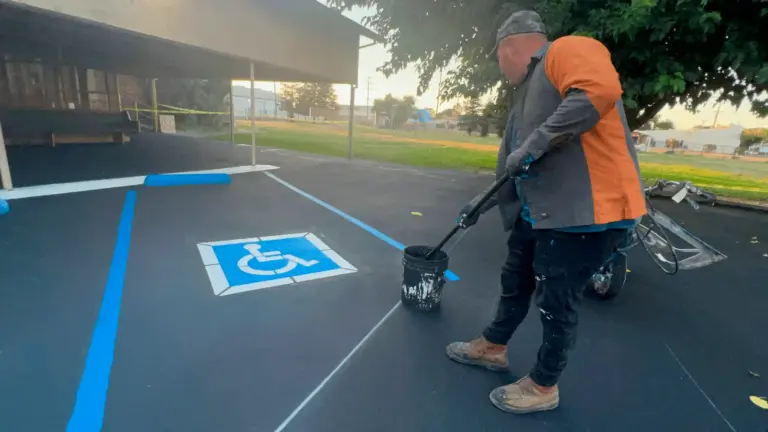
Staying compliant with evolving state and federal accessibility mandates requires continuous monitoring of physical infrastructure and administrative rules. Subscribe to the ADA Paving California editorial update newsletter or download our free compliance checklist to help keep your agency’s parking facilities and public rights-of-way aligned with current California standards.
References
-
U.S. Department of Justice. (2010). 28 C.F.R. Part 35 – Nondiscrimination on the Basis of Disability in State and Local Government Services, Section 35.104 Definitions. Code of Federal Regulations. https://www.ada.gov/law-and-regs/regulations/title-ii-2010-regulations/
-
U.S. Department of Justice. (2010). 28 C.F.R. Section 35.107 Designation of Responsible Employee and Adoption of Grievance Procedures. Code of Federal Regulations. https://www.ada.gov/law-and-regs/regulations/title-ii-2010-regulations/
-
U.S. Department of Justice. (2010). 28 C.F.R. Section 35.150 Existing Facilities and Program Accessibility. Code of Federal Regulations. https://www.ada.gov/law-and-regs/regulations/title-ii-2010-regulations/
-
U.S. Department of Justice. (2010). 28 C.F.R. Section 35.151 New Construction and Alterations. Code of Federal Regulations. https://www.ada.gov/law-and-regs/regulations/title-ii-2010-regulations/
-
U.S. Department of Justice. (2024). 28 C.F.R. Section 35.200 Accessibility of State and Local Government Websites and Mobile Apps. Federal Register. https://www.ada.gov/law-and-regs/regulations/title-ii-2010-regulations/
-
California Building Standards Commission. (2022). California Building Code Title 24, Part 2, Chapter 11B. California Department of General Services. https://www.dgs.ca.gov/DSA/Accessibility
-
California State Legislature. (2012). California Civil Code Section 55.56 – Statutory Damages for Construction-Related Accessibility Standards. California Legislative Information. https://leginfo.legislature.ca.gov/
All references verified and publicly accessible
adapaving.org