An ADA violation occurs when a commercial facility, public accommodation, or government property maintains physical, architectural, or structural barriers that restrict equal access for individuals with disabilities. Under Title III of the Americans with Disabilities Act, business owners and commercial landlords bear strict liability for maintaining accessible premises meaning lack of knowledge or absence of discriminatory intent provides no defense against non-compliance. In California, physical barrier violations trigger a dual-layer of legal exposure, combining federal injunctive mandates with severe state financial penalties. Understanding how accessibility standards apply to physical structures particularly exterior routes, ramps, and parking facilities is essential for property managers seeking to mitigate litigation risks and maintain regulatory compliance.
What Is an ADA Violation in Commercial Real Estate?
An ADA violation in commercial real estate is any physical, architectural, or communication barrier that prevents individuals with disabilities from fully accessing a place of public accommodation. Under Title III of the Americans with Disabilities Act, codified in 28 CFR Part 36, places of public accommodation including shopping centers, office parks, restaurants, and private educational facilities must ensure their facilities comply with federal accessibility guidelines. A violation exists whenever a built element fails to meet specific dimensional, structural, or operational tolerances established by the 2010 ADA Standards for Accessible Design, regardless of whether the property owner acted in good faith or was unaware of the defect.
Understanding what is the ADA requires recognizing that liability under Title III is absolute and non-transferable. Commercial property owners and tenants share joint responsibility for maintaining accessible premises. Leases that attempt to assign full ADA liability to a tenant do not shield the property owner from federal enforcement actions or private civil lawsuits. When an accessibility barrier exists on a property, both the landlord and the operating tenant remain potential targets for legal action.
Physical accessibility violations generally fall into three distinct operational categories within commercial properties:
- Exterior Approach and Entrance Barriers: Non-compliant slope gradients on curb ramps, missing designated accessible parking spaces, uneven pavement surfaces exceeding maximum vertical displacement limits, and non-conforming door threshold heights.
- Interior Access Barriers: Inadequate aisle clearance widths, improperly mounted restroom fixtures, non-compliant door opening forces, and service counters that exceed maximum allowable reach ranges.
- Maintenance of Accessible Features: Allowing accessible elements to fall into disrepair, such as broken auto-door operators, obstructed access aisles, faded striping, or accumulating debris along continuous accessible paths of travel.
Federal law mandates that public accommodations must remove architectural barriers in existing facilities where such removal is readily achievable defined as easily accomplishable and able to be carried out without much difficulty or expense under 42 U.S.C. 12181(9). However, when alterations or new construction take place, strict adherence to technical standards is mandatory, and cost considerations no longer excuse non-compliance.
Federal Penalties vs. California Statutory Damages
The financial consequences of an accessibility violation depend significantly on whether enforcement occurs under federal jurisdiction or through California state courts. At the federal level, private plaintiffs bringing claims under Title III of the ADA cannot recover monetary damages; their remedy is limited to injunctive relief a court order requiring barrier removal along with the recovery of reasonable attorney fees. Monetary civil penalties under federal law are reserved exclusively for public interest enforcement actions initiated by the United States Department of Justice. Pursuant to 28 CFR Section 36.504, maximum federal civil penalties for Title III violations stand at $75,000 for a first violation and $150,000 for subsequent violations, as adjusted periodically under the Federal Civil Penalties Inflation Adjustment Act.
In California, however, a physical ADA violation automatically constitutes a violation of state civil rights law, creating immediate financial exposure for property owners. Under the Unruh Civil Rights Act, specifically California Civil Code Section 52(a), any violation of the federal ADA constitutes a direct violation of state law. Unlike federal law, California permits private plaintiffs to recover statutory damages without proving intentional discrimination. Under California Civil Code Section 55.56, a plaintiff who personally encounters an accessibility barrier or was deterrence-impacted from accessing a facility can claim a minimum statutory damage award of $4,000 per violation occasion, plus mandatory attorney fees.
The statutory minimum of $4,000 per occasion under California law creates cumulative financial liability. If a serial plaintiff visits a non-compliant property three separate times, the court may award $12,000 in statutory damages, plus accumulated legal fees that frequently exceed the cost of the physical repair itself. Property owners must realize that fulfilling federal guidelines alone does not provide immunity from California litigation if specific state building codes are breached.
Comparison of Enforcement Standards: Federal ADA Title III vs. California Unruh Civil Rights Act
| Enforcement Metric | Federal ADA Title III (28 CFR Part 36) | California Unruh Act (Civil Code Section 52(a)) |
|---|---|---|
| Private Plaintiff Monetary Remedy | Injunctive Relief & Attorney Fees Only (No Private Damages) | Minimum $4,000 Statutory Damages per Occasion + Attorney Fees |
| Civil Penalties (Government Enforcement) | Up to $75,000 (First Offense) / $150,000 (Subsequent) | Varies based on local prosecution and civil rights enforcement actions |
| Requirement to Prove Intent | Not Required (Strict Liability for Physical Barriers) | Not Required for ADA-Based Violations (Civil Code Section 51(f)) |
| Legal Trigger for Financial Claim | Presence of Architectural Barrier | Encountering Barrier or Proof of Deterrence (Civil Code Section 55.56) |
Common Physical ADA Violations in Parking Lots and Exterior Routes
Exterior parking facilities and access paths generate the majority of accessibility litigation in California due to their exposure to public view and measurable physical standards. Unlike interior space modifications that require physical entry, exterior non-compliance can be documented directly from a vehicle or public sidewalk. While federal standards mandate baseline requirements under 2010 ADAAG, California Building Code Title 24, Chapter 11B enforces stricter geometric and visual tolerances.
The most frequent exterior accessibility violations identified in commercial real estate include:
- Non-Compliant Surface Slopes and Cross Slopes: Both federal and California standards require accessible parking stalls and adjacent access aisles to maintain cross slopes and running slopes no steeper than 1:48 (2.08%). Under California Building Code Section 11B-502.4, slope tolerances apply to every square foot of the designated stall and aisle. Asphalt settlement, improper grading, or surface deterioration exceeding 2.08% slope creates an immediate violation.
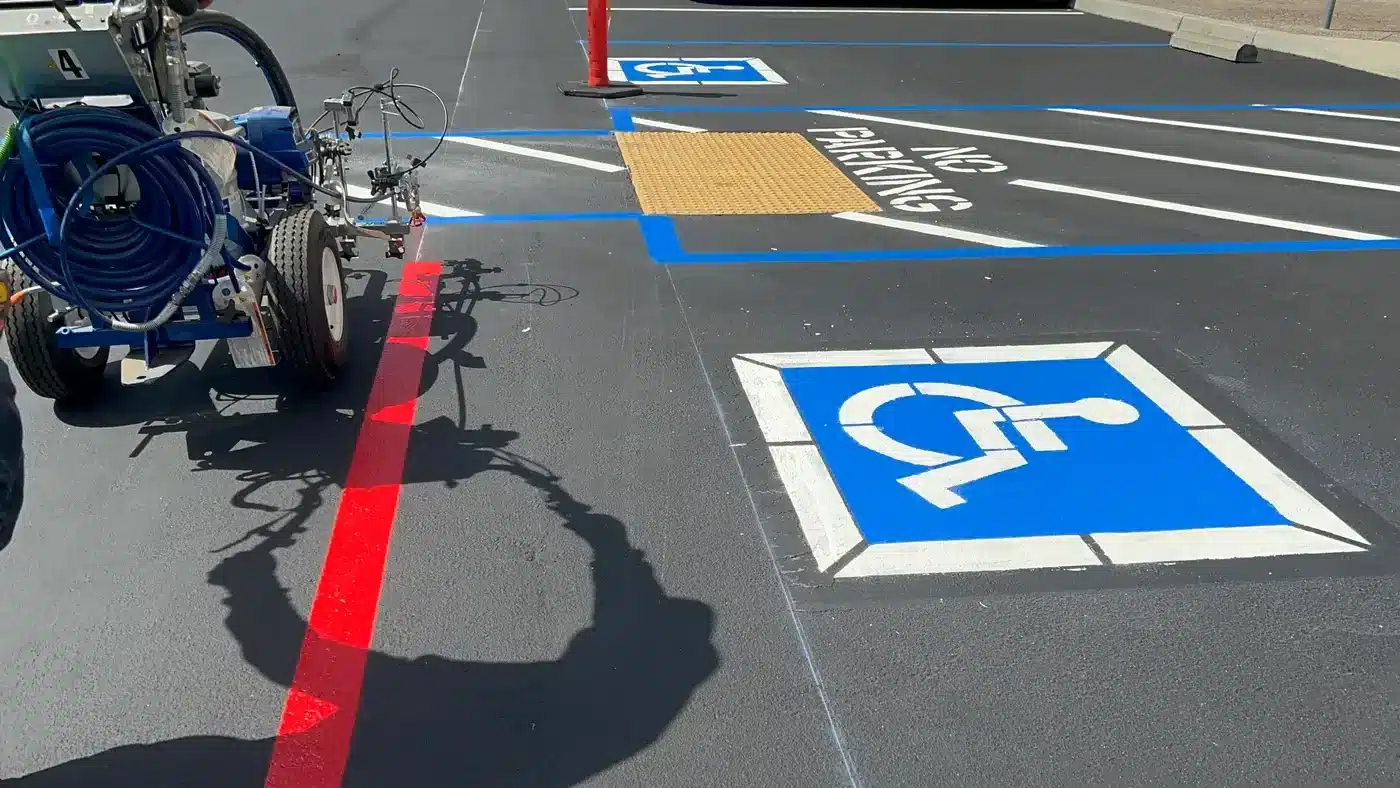
- Improper Access Aisle Dimensions and Markings: Under California Building Code Section 11B-502.3, access aisles must measure at least 60 inches wide for standard accessible stalls and 96 inches wide for van-accessible stalls. Additionally, California imposes strict painted marking requirements: access aisles must be outlined in blue, feature diagonal hatched lines spaced no more than 36 inches apart, and display the phrase “NO PARKING” painted in white block letters at least 12 inches high within the border.
- Inadequate Visual Identification and Tow Signage: California Building Code Section 11B-502.6 requires international symbol of accessibility (ISA) signs mounted at a minimum height of 60 inches above the finish surface, measured to the bottom of the sign. Signs must include mandatory supplementary wording: “Minimum Fine $250” signs must be mounted directly below the ISA emblem. Furthermore, a property entrance sign measuring at least 17 inches by 22 inches must be posted at each vehicle entrance containing precise towing notification language and enforcement telephone numbers.
- Curb Ramp and Path of Travel Deficiencies: Where an accessible route crosses a curb, a curb ramp must be installed with a maximum running slope of 1:12 (8.33%). California Building Code Section 11B-406 requires curb ramps to feature a 36-inch deep panel of visual contrast truncated domes (detectable warnings) extending the full width of the ramp surface. Omission of detectable warnings or failure to maintain a continuous, unobstructed 48-inch wide exterior path of travel constitutes an actionable breach under both state and federal law.
The Role of Title II and Title III in ADA Non-Compliance
Understanding the statutory distinction between Title II and Title III of the Americans with Disabilities Act is crucial when assessing legal obligations and enforcement mechanisms. While both titles prohibit discrimination based on disability, they govern fundamentally different categories of entities and establish distinct compliance pathways.
Title III applies exclusively to private entities that operate places of public accommodation, commercial facilities, or private transportation services. Title III covers private businesses regardless of size from sole proprietorship retail shops to multinational commercial property management portfolios. Under Title III, compliance focuses on maintaining accessible facilities, removing architectural barriers where readily achievable, and ensuring new construction complies strictly with accessibility standards. Private enforcement under Title III relies on individual civil lawsuits, whereas public enforcement falls under the authority of the U.S. Department of Justice.
By contrast, ADA Title II obligations apply strictly to state and local government entities, public transit authorities, and municipal operations. Title II mandates that government bodies ensure all public programs, services, and activities are accessible when viewed in their entirety. Key operational differences between Title II and Title III obligations include:
- Program Accessibility Standard: Title II entities may satisfy compliance by relocating programs to accessible facilities, whereas Title III private entities must remove physical architectural barriers within their specific structures.
- Self-Evaluation and Transition Plans: Title II public entities employing 50 or more individuals are required to perform comprehensive self-evaluations and maintain official ADA Transition Plans documenting schedules for structural modifications in public rights-of-way and facilities.
- Enforcement Framework: Federal agencies can withhold federal financial assistance from non-compliant Title II entities, and private individuals can seek monetary damages against public entities in federal court upon demonstrating deliberate indifference.
Commercial property owners leasing space to government tenants (such as state agencies or municipal services) must ensure their properties satisfy both Title III public accommodation rules and Title II program accessibility mandates to avoid cross-jurisdictional liability.
How Business Owners Can Mitigate Exposure to Accessibility Lawsuits
Mitigating legal exposure to accessibility lawsuits in California requires an active compliance strategy that establishes legal protections prior to receiving a complaint. Waiting for a lawsuit to audit physical assets leaves property owners exposed to mandatory statutory damages under California law. Because lack of knowledge is not a recognized legal defense, commercial real estate managers must utilize proactive state-backed inspection frameworks to reduce vulnerability.
The most effective legal shield available to California commercial property owners is obtaining an inspection by a Certified Access Specialist (CASp). Created under the Construction-Related Accessibility Standards Compliance Act (CRASCA), the CASp program provides specific statutory benefits under California Civil Code Section 55.54. Properties inspected by a CASp prior to a lawsuit earn “qualified defendant” status in state court, which unlocks crucial legal protections:
- 90-Day Stay of Proceedings: Qualified defendants can request an immediate 90-day court stay of litigation upon receiving a summons, halting legal fee accumulation while the court conducts an early evaluation conference.
- Early Evaluation Conference: The court schedules an early settlement conference overseen by a judge or commissioner to evaluate the validity of the claim before formal discovery expenses mount.
- Statutory Damage Reduction: Under California Civil Code Section 55.56(f), statutory damages may be reduced from $4,000 down to $1,000 per occasion if the property owner corrects all identified physical barriers within 60 days of being served with a complaint, provided a CASp inspection was performed prior to the lawsuit.
In addition to securing a CASp audit, commercial landlords should implement routine maintenance protocols for all exterior paths of travel. Maintaining logbooks of pavement repairs, regular re-striping schedules, continuous sign inspections, and immediate remediation of asphalt settling demonstrates due diligence. When undertaking asphalt repaving or parking lot modification projects, property owners must ensure that asphalt contractors adhere strictly to California Building Code Chapter 11B geometric standards, as even minor grading deviations can trigger actionable accessibility non-compliance.
Stay Ahead of California Accessibility Regulations
California accessibility standards under CBC Chapter 11B and Civil Code updates evolve frequently. Subscribe to the ADA Paving editorial updates to receive technical compliance guides, regulatory alerts, and actionable property inspection frameworks designed specifically for California commercial property managers and owners.
References
-
U.S. Department of Justice. (2010). 2010 ADA Standards for Accessible Design, 28 CFR Part 36, Section 36.504. U.S. Department of Justice. https://www.ada.gov/law-and-regs/title-iii-regulations/
-
California State Legislature. (2016). California Civil Code Section 52(a) and Section 55.56, Unruh Civil Rights Act. California Legislative Information. https://leginfo.legislature.ca.gov/faces/codes_displaySection.xhtml?lawCode=CIV§ionNum=52
-
California Building Standards Commission. (2022). California Building Code, Title 24, Part 2, Chapter 11B: Accessibility to Public Buildings. California Department of General Services. https://www.dgs.ca.gov/DSA/Publications/page-content/building-standards-and-regulations
All references verified and publicly accessible
adapaving.org