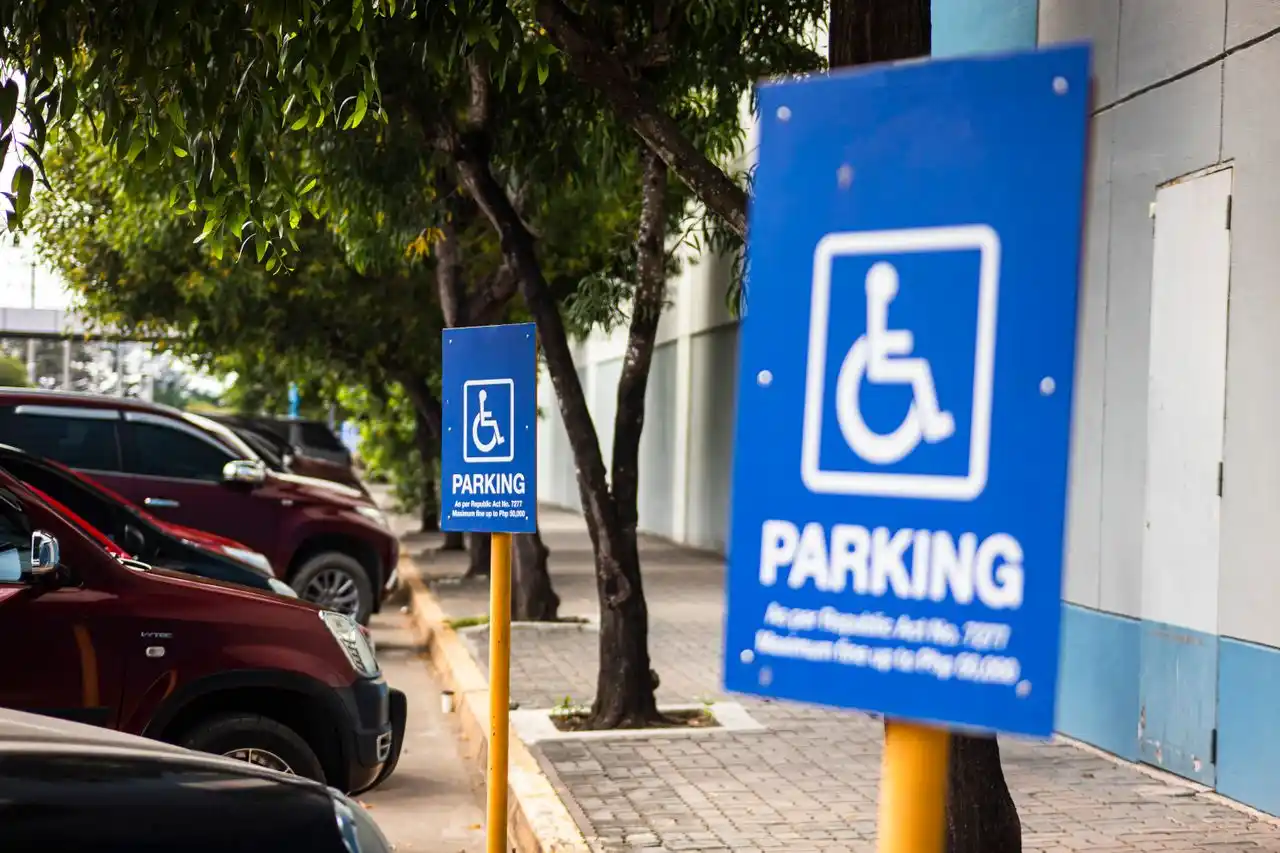
California requires an accessible path of travel whenever alterations or additions are made to an existing building or facility, running to the specific area of the work. Federal law asks a narrower question and applies the duty only when the altered area contains a primary function. Resurfacing or restriping a parking lot, on its own, triggers neither.
That distinction is written into the same code section as the trigger, and the parking lot exemption sits fifth in a list of ten exceptions where almost nobody reads. So contractors reach for the federal resurfacing rule instead, which was written for public streets and does not say the same thing.
What Counts as a Path of Travel in California
California’s Building Code Chapter 11B requires that when alterations or additions are made to an existing building or facility, an accessible path of travel be provided to the specific area of the work. The code names five components of that primary accessible path: a primary entrance, toilet and bathing facilities serving the area, drinking fountains serving the area, public telephones serving the area, and signs. Pavement is not on that list. It gets there another way.
It enters through the Chapter 2 definition, which is broader than that five item list and describes a path of travel as an identifiable accessible route within an existing site by which an area may be approached, entered and exited, and which connects that area with an exterior approach including sidewalks, streets and parking areas. The moment the exterior approach is named, the asphalt between the stall and the front door is inside the scope.
Federal law is blunter about it: 28 CFR Section 36.403 names parking access aisles outright as a component of an accessible path of travel.
One narrower point matters on a small scope of work. California lists signs among its five elements, so a project that has already pulled the trigger may have to bring them up to code. Neither system treats sign work as the trigger itself: federal law excludes signage from the alterations that affect a primary function area, and California reaches the same result through Exception 6.
When Paving Work Triggers Path of Travel Upgrades, and When It Does Not
Resurfacing and restriping an existing parking lot do not trigger the path of travel obligation in California. Exception 5 to Section 11B-202.4 limits that work to the actual scope of the project and states it is not required to comply with the section. The exemption is narrower than it looks. It releases the trigger, not the standards that govern whatever you touched.
The principle behind it is that maintenance is not an alteration. The Division of the State Architect puts it plainly: projects limited to maintenance are not alterations and do not trigger additional accessibility requirements. Federal law draws the same line and adds the caveat that decides close cases. Normal maintenance stops being maintenance the moment it affects usability.
| Scope of work | How the code treats it | Path of travel upgrade required |
|---|---|---|
| Crack sealing, fog seal, slurry seal, chip seal | Maintenance in federal road guidance; no California text names these treatments | No |
| Sealcoating an existing lot | Surface sealing, same federal guidance | No |
| Asphalt overlay on an existing lot | Resurfacing under Exception 5 | No |
| Mill and overlay on an existing lot | Resurfacing under Exception 5 | No |
| Restriping an existing lot | Restriping under Exception 5 | No |
| Installing ramps, cutting curbs, creating designated accessible spaces | Barrier removal under Exception 4 | No |
| Reroofing, HVAC, cosmetic work | Exception 7, unless usability is affected | No |
| Altering an area that contains a primary function | The rule applies in full | Yes, subject to Exception 8 |
Those first two rows rest on federal road guidance, because neither Chapter 11B nor the state architect names crack sealing, slurry, chip seal or sealcoating anywhere, and that same guidance warns that several maintenance treatments combined at or near the same time can add up to an alteration. The rest of the table rests on Chapter 11B itself.
A no in that column means the paving work did not oblige you to rebuild the route to the front door. It does not mean the work is unregulated. When a lot is restriped, the Department of Justice is direct about the consequence: a covered entity that restripes a parking lot must provide accessible parking spaces as required by the Standards, and failing to do so violates the ADA. The stall dimensions and the access aisle markings still have to land where the code puts them.
One tolerance bites here more often than any other. In accessible stalls and their access aisles, no change in level is permitted and no slope may exceed 1:48 in any direction. A fresh overlay that feathers into an existing stall is the most common way that rule gets broken, and nothing about Exception 5 forgives it.
The last row is the one that costs money, and it has nothing to do with asphalt. Federal law limits the duty to areas containing a primary function, a major activity the facility exists for. California Section 11B-202.4 has no such filter. Any alteration or addition to an existing building puts the route to the work in scope, subject to the ten exceptions the section then lists.
The 20 Percent Cap and the 2026 Valuation Threshold
When an alteration does pull the trigger, Exception 8 to Section 11B-202.4 limits what you have to spend, but only below a dollar line the state resets every January. For 2026 the Division of the State Architect set that line at 209,208 dollars of adjusted construction cost. Below it, 20 percent is a ceiling. Above it, the same 20 percent turns into a floor. Most summaries of this rule report only the ceiling.
One caution before that number goes into a budget. It is published by the Division of the State Architect, whose own jurisdiction is schools and state buildings, so a privately owned shopping center confirms the figure with its local building official instead. That office, not the state, is the one that applies the code to your project.
Below the line, the cost of complying with the path of travel section is capped at 20 percent of the adjusted construction cost, and where full compliance would cost more, you comply to the greatest extent possible without crossing that 20 percent. Above the line the posture flips. Full compliance is expected, and if the enforcing agency makes a finding of unreasonable hardship, the code still states that in no case shall the cost of compliance be less than 20 percent. In the process the state architect publishes, a project priced under the threshold cannot request an unreasonable hardship finding at all, because the 20 percent cap is already the relief.
What counts toward that cost decides everything downstream. In: labor, material, equipment, services, utilities, contractor financing, contractor overhead and profit, and construction management costs. Out: project management fees, architectural and engineering fees, testing and inspection fees, utility connection fees, and the path of travel improvements themselves.
Exception 8 also sets an order of priority: an accessible entrance first, then the accessible route to the altered area, then a restroom, then telephones, then drinking fountains, and last of all, where possible, additional elements such as parking, signs, storage and alarms. Owners who assume the budget starts with the accessible stalls out front have it backwards. The code puts parking in the final group of the six, and it frames the order as a recommendation rather than a command.
The last provision closes the obvious loophole. If an area is altered without providing an accessible path of travel, and further alterations to that area or to another area on the same path happen within three years, the code adds up the cost of all of them to decide whether the expense was disproportionate. Splitting one project into three annual phases does not reset the math.
How the Federal Rule and the California Rule Split
Both systems use the number 20 percent, and the federal version measures it against the cost of the alteration to the primary function area with no dollar threshold attached. The valuation threshold and the parking lot exemption are California additions with no federal counterpart. Which system you answer to decides more than the arithmetic does, and most of the confusion in this field comes from mixing the two.
The costlier confusion is about which law is speaking. In 2013 the Department of Justice and the Federal Highway Administration issued joint guidance stating that resurfacing is an alteration that triggers the requirement to add curb ramps, including new layers of asphalt with or without milling. Those documents get quoted constantly in discussions about parking lots. They were written under Title II, and they govern streets, roads and highways owned by state and local governments.
A private commercial parking lot is Title III territory, and in California it answers to Chapter 11B, where Exception 5 says what it says. The federal guidance still matters if the lot belongs to a public agency. If you own a retail center, it is describing someone else’s obligation. That split between public entities and private businesses is the same one that separates the rules for a school district or a city from the rules for a shopping center, and it is worth checking before anyone quotes a curb ramp requirement at you.
A 2015 supplement went further and confirmed that milling followed by an overlay is an alteration regardless of the final height. One more misquote travels with it. The Department of Justice design guide that gets cited for sealcoating and repaving addresses restriping and nothing else: the words sealcoating and resurfacing do not appear in it. Its holding on restriping still stands, but its stall counts run against the 1991 standard, superseded in 2010.
Walking Surface Rules California Adds That the Federal Standard Does Not
Once pavement sits inside the path of travel it has to meet the walking surface rules. Running slope may not exceed 1:20 and cross slope may not exceed 1:48 in both systems, so far so familiar. Three California requirements have no federal counterpart at all, and a paving contractor controls each one directly with the grade and the forms. They govern one leg of a longer trip, and which rule applies to each leg of the full route changes as the surface changes.
Sidewalks and walks in California must be 48 inches clear. The enforcing agency can allow 36 inches, but only on a finding of unreasonable hardship from right of way restrictions, natural barriers or other existing conditions. The federal standard sets 36 inches and stops there. Build to the federal number in California and the walk is a foot short.
Any walk with a continuous gradient needs resting areas 60 inches long at intervals of no more than 400 feet, as wide as the walk and sloped no more than 1:48 in every direction. No equivalent section exists in the 2010 federal standards, and on a long site approach it changes the grading plan, not just the striping.
Where an abrupt change in level greater than 4 inches separates a walk from an adjacent surface, California requires a warning curb at least 6 inches high above the walk, and federal law has no such rule. The exception matters here: no curb is required between a walk and an adjacent street or driveway, which is precisely the edge most parking lots present.
Changes in level up to a quarter inch may be vertical. Between a quarter inch and a half inch they must be beveled no steeper than 1:2. Anything above a half inch becomes a ramp under Section 11B-405, capped at 1:12. A walking surface crosses into ramp territory the moment it runs steeper than 5%, and a regraded approach crosses that line by accident.
What the Statute Forgives, and What It Does Not
California attaches statutory damages to access barriers that federal law does not, and two items inside that statute are pure pavement. Civil Code Section 55.56 presumes that the color of parking lot striping did not cause difficulty, provided the striping exists and contrasts enough with the surface to stay reasonably visible, and it makes the same presumption for faded, chipped, damaged or deteriorated paint in stalls and access aisles that are otherwise fully compliant, provided the markings still show the required dimensions in a reasonably visible way.
Both presumptions are rebuttable. Both reach only a defendant that meets the small business test and corrects quickly, so treat them as a cushion, not a shield. And note what the cushion does not cover: a stall that is too narrow or an access aisle that is too short is a dimensional failure, not a paint and stencils problem, and no amount of fresh paint resolves it. The wider scheme of statutory damage minimums under the Unruh Civil Rights Act runs on its own track.
California rewrites Chapter 11B on a three year cycle and resets the valuation threshold every January, so the two numbers that decide this analysis both have expiration dates. The 2025 code took effect on January 1, 2026, and the threshold moves again in January 2027. Subscribe to get an alert when either one changes, or download our free regulatory guide to keep the current figures next to your next paving proposal.
References
-
U.S. Department of Justice. (2010). 2010 ADA Standards for Accessible Design, Sections 202.4, 206.2, 302.1, 303.2, 303.3, 402.2, 403.3, 403.5.1, 405.2 and 502.4. U.S. Department of Justice. https://www.ada.gov/law-and-regs/design-standards/2010-stds/
-
U.S. Department of Justice. (2010). Nondiscrimination on the Basis of Disability by Public Accommodations and in Commercial Facilities, 28 CFR Part 36, Sections 36.402 and 36.403. U.S. Department of Justice. https://www.ada.gov/law-and-regs/regulations/title-iii-regulations/
-
U.S. Department of Justice and Federal Highway Administration. (2013). Joint Technical Assistance on the Title II of the Americans with Disabilities Act Requirements to Provide Curb Ramps when Streets, Roads, or Highways are Altered through Resurfacing. U.S. Department of Justice. https://archive.ada.gov/doj-fhwa-ta.htm
-
U.S. Department of Justice and Federal Highway Administration. (2015). Questions and Answers: Supplement to the 2013 DOJ/DOT Joint Technical Assistance on Resurfacing, Answer A2. U.S. Department of Justice. https://archive.ada.gov/doj-fhwa-ta-supplement-2015.html
-
U.S. Department of Justice, Civil Rights Division, Disability Rights Section. ADA Design Guide 1: Restriping Parking Lots. U.S. Department of Justice. https://archive.ada.gov/restripe.pdf
-
Division of the State Architect, Department of General Services. (2025). 2025 California Access Compliance Advisory Reference Manual, Chapter 2 Definitions and Chapter 11B Sections 11B-202.4, 11B-303, 11B-403 and 11B-502. State of California. https://www.dgs.ca.gov/-/media/Divisions/DSA/Publications/access/2025-CBC-Advisory-Manual-Triennial.pdf
-
Division of the State Architect, Department of General Services. (2025). Interpretation of Regulations IR 11B-10, Scoping and Path of Travel Improvement Requirements for Facility Alteration, Addition and Structural Repair Projects, Sections 1.3, 2.2, 4.2, 4.3, 5.1 and 5.2. State of California. https://www.dgs.ca.gov/-/media/Divisions/DSA/Publications/interpretations_of_regs/IR_11B-10.pdf
-
Division of the State Architect, Department of General Services. (2024). Procedure PR 24-04, Request for Finding of Unreasonable Hardship per CBC 11B-202.4 Exception 8, Section 1.2.3. State of California. https://www.dgs.ca.gov/-/media/Divisions/DSA/Publications/procedures/PR_24-04.pdf
-
Division of the State Architect, Department of General Services. (2026). Valuation Threshold Update for 2026. State of California. https://www.dgs.ca.gov/DSA/News/Page-Content/Division-of-the-State-Architect-News-List-Folder/Valuation-Threshold-Update-for-2026
-
California Legislature. California Civil Code Section 55.56, subdivisions (e), (f) and (g). California Legislative Information. https://leginfo.legislature.ca.gov/faces/codes_displaySection.xhtml?lawCode=CIV§ionNum=55.56.
All references verified and publicly accessible
adapaving.org